

A Series of New Policies Effective from July 1, 2026
From July 1, 2026, several important documents related to investment, construction, environment, and project management will officially come into effect. Notable among these are Resolution 66.18/2026/NQ-CP, Resolution 66.19/2026/NQ-CP, Decree 217/2026/ND-CP, Decree 212/2026/ND-CP, and Decision 1165/QD-BTC.
While each document individually represents changes across various sectors, when viewed together, they reveal a clear direction from the Government:
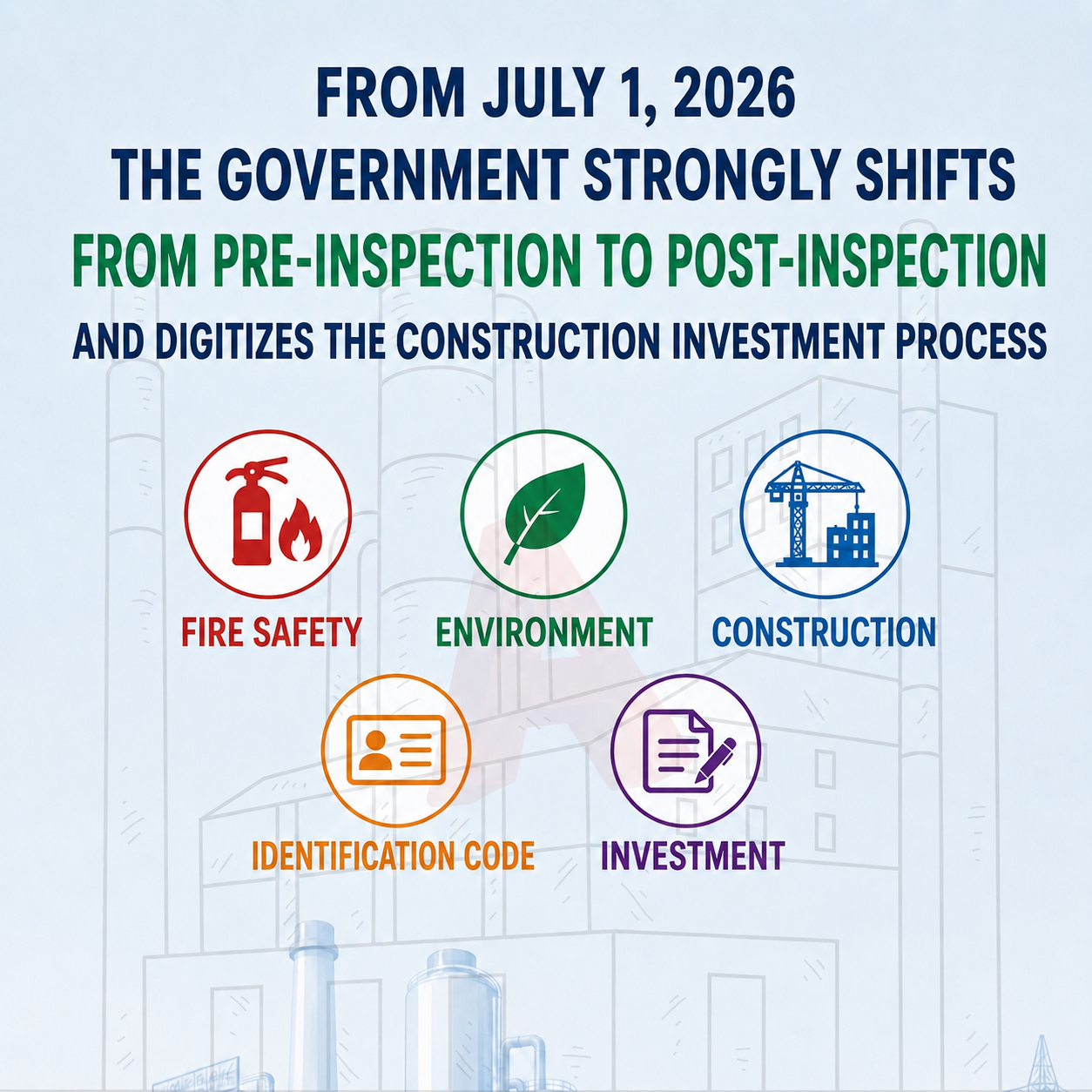
> Reducing pre-approval, increasing post-approval, and promoting digitalization throughout the entire lifecycle of investment and construction projects.
For investors in factories, industrial parks, logistics warehouses, or businesses planning to expand production, these changes can directly impact investment preparation time, implementation progress, and legal compliance costs.
Resolution 66.18: Reducing Fire Safety Procedures, Easing Pressure on Project Schedules
For many years, fire safety has always been a major concern for businesses due to its direct impact on the time it takes to put a project into operation.
According to Resolution 66.18/2026/NQ-CP, many administrative procedures in the field of fire safety have been reduced or simplified. Most notably, the procedure for inspecting and accepting fire safety work has been abolished for many projects whose designs have already been approved.
This change directly impacts projects such as:
- Manufacturing plants;
- Industrial workshops;
- Logistics warehouses;
- Cold storage facilities;
- Distribution centers;
- Commercial and service projects. Previously, many projects had completed construction but still had to wait for acceptance procedures to be eligible for operation. With the new mechanism, the time to prepare for putting projects into use is expected to be significantly shortened.
However, this does not mean that safety standards will be relaxed. The responsibility of the investor, design unit, and construction contractor will be higher as the post-inspection mechanism is strengthened.
Resolution 66.19: Not all projects still need to apply for an Environmental Permit
While Resolution 66.18 impacted fire safety, Resolution 66.19/2026/NQ-CP is considered one of the biggest changes in the environmental field.
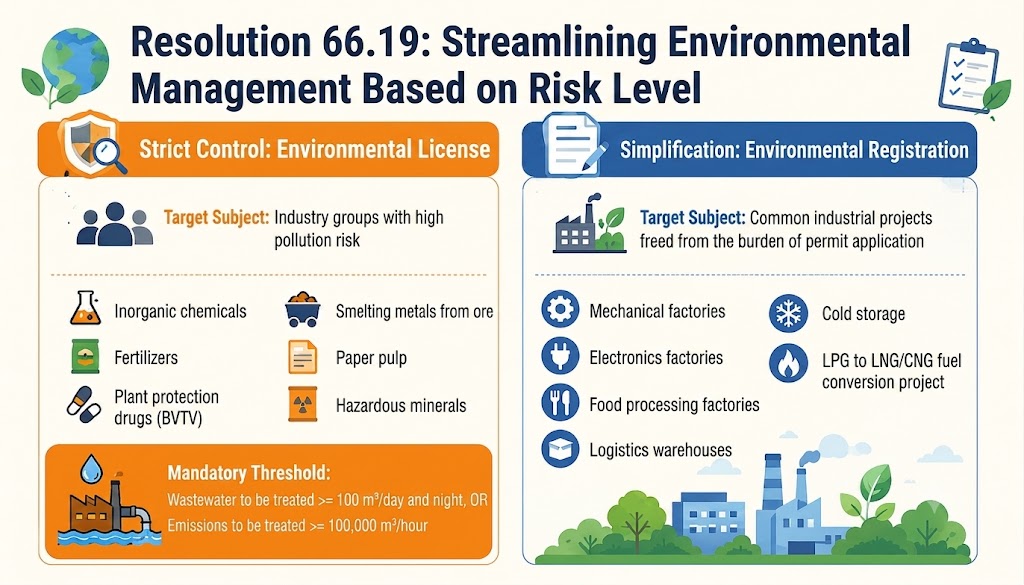
According to the new regulations, the scope of projects requiring an Environmental Permit has been significantly narrowed. Some industries with high pollution risks are still subject to strict management, including:
- Inorganic chemicals;
- Chemical fertilizers;
- Pesticides;
- Metallurgy from ore;
- Paper production with pulp production stage;
- Processing of hazardous minerals.
Projects in this group still require an Environmental Permit when:
* Wastewater requiring treatment is 100 m³/day or more;
* Or exhaust gas requiring treatment is 100,000 m³/hour or more.
Conversely, many common industrial projects such as:
- Mechanical factories;
- Electronic factories;
- Food factories;
- Logistics warehouses;
- Cold storage facilities;
Some projects converting LPG fuel to LNG or CNG; may have simplified environmental procedures and in many cases only require environmental registration instead of an Environmental Permit as before.
This change is considered to have a significant impact on the investment preparation time for businesses, especially for production expansion projects or the construction of new factories.