


From April 22, 2026, Decision 963/QD-BCT will apply a new timeframe for hourly electricity pricing (TOU – Time of Use), while Circular 60/2025/TT-BCT, effective from December 2, 2025, stipulates how to apply electricity tariffs to different customer groups.
This does not mean a uniform increase in electricity prices. However, for large electricity-consuming manufacturing businesses, especially those operating heavily in the evenings or running continuously 24/7, electricity costs could change significantly if operating plans are not adjusted.
-
How have peak hours changed?
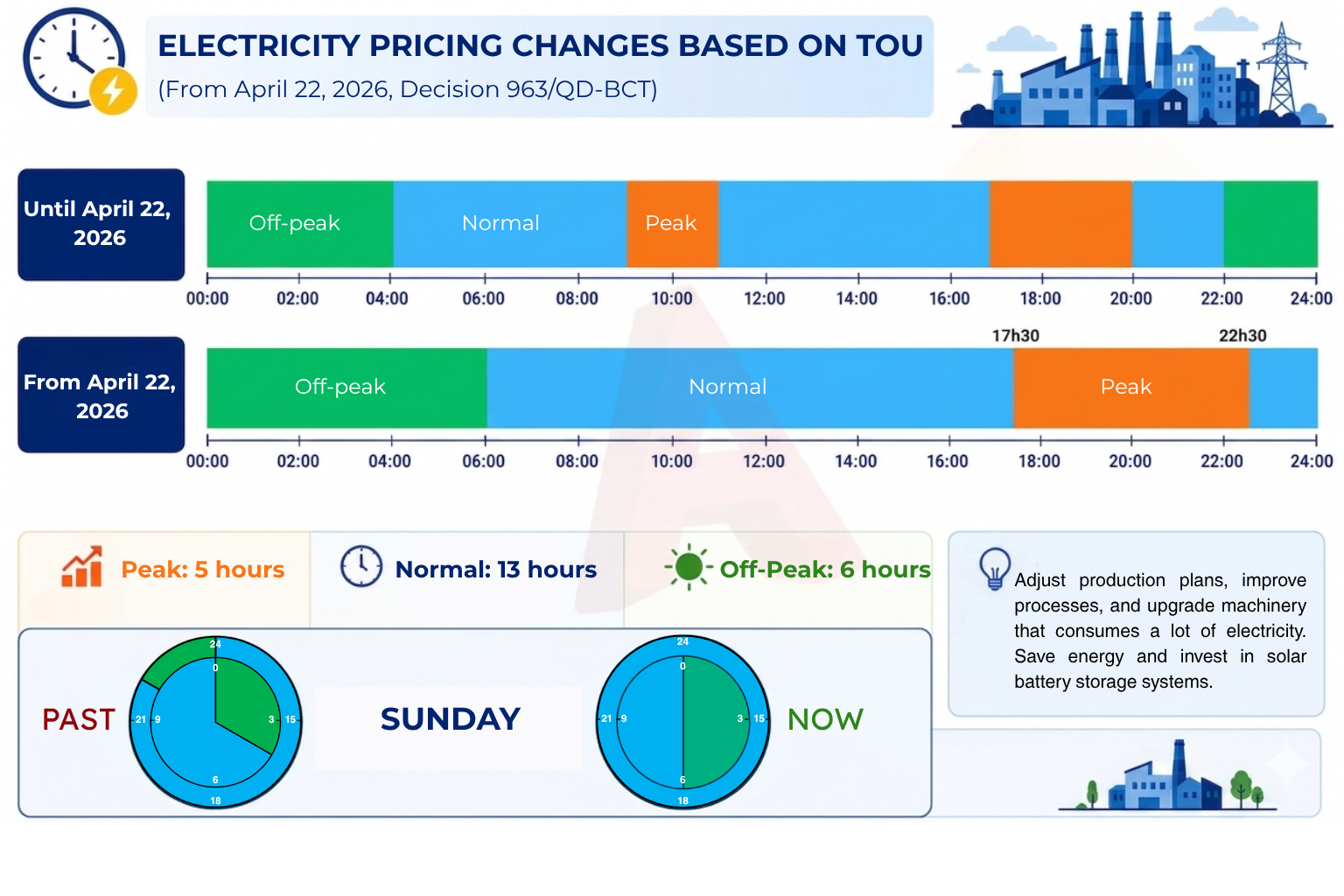
According to Decision 963/QD-BCT, peak hours have been adjusted to focus more heavily on the evening – the time when electricity demand is high but solar power generation is low. Specifically:
|
|
From Monday to Saturday |
Sunday |
||
|
Until April 22, 2026 |
From April 22, 2026 | Until April 22, 2026 |
From April 22, 2026 |
|
| Off-peak hours | 0h-04h, 22h-24h | 00h00 – 06h00 | 0h-04h, 22h-24h | 00h00 – 06h00 |
| Normal hours | 04h-9h30, 11h30 -17h, 20h-22h | 06h00 – 17h30 and 22h30 – 24h00 | 04h-22h | 06h00 – 24h00 |
| Peak hours | 9h30-11h30, 17h-20h | 17h30 – 22h30 (5 giờ) | without peak hours | without peak hours |
The goal is to balance the national power grid load and optimize power generation operation..
-
Applicable subjects
The following entities are required to apply time-of-day electricity pricing:
- Electricity buyers using electricity for production and business purposes who are supplied with electricity through dedicated transformers of 25 kVA or more, or whose average electricity consumption for three consecutive months is 2,000 kWh/month or more;
- Electricity retailers in industrial parks and clusters;
- Electricity buyers who resell electricity for non-residential purposes in commercial-service-residential complexes.
Specifically, this includes: Factories operating 2-3 shifts, cold storage facilities, logistics centers, shopping malls, etc.
- Groups less affected: Households, small businesses, small offices.
-
What are the actual impacts?
Average electricity prices during business hours have decreased, but they have increased at night, directly impacting factories and businesses that operate 24 hours a day.
For example, a food processing plant operating 24 hours a day:
– Power consumption of 5,000 kWh/day
=> 150,000 kWh/month ≈ Approximately 400 million VND/month in electricity costs
| Before the change: – Peak hours: 1,800 kWh/day – Normal hours: 2,000 kWh/day – Off-peak hours: 1,200 kWh/day → Cost: ~391.8 million VND/month |
After the change: – Peak hours: 2,200 kWh/day – Normal hours: 1,800 kWh/day – Off-peak hours: 1,000 kWh/day → Cost: ~413.4 million VND/month |
Difference: +21.6 million/month → Nearly 260 million/year
4. What should businesses do?
- Shifting maximum load: Move the most energy-intensive processes to the 0h-6h timeframe. Maximize Sundays for urgent orders or mass production.
- Upgrade to high-efficiency equipment and implement comprehensive energy saving measures.
- Install solar power systems, integrating storage during the day and generating electricity at night during peak hours.
The issue isn’t just about using less electricity, but about using electricity more efficiently at each time of day.